
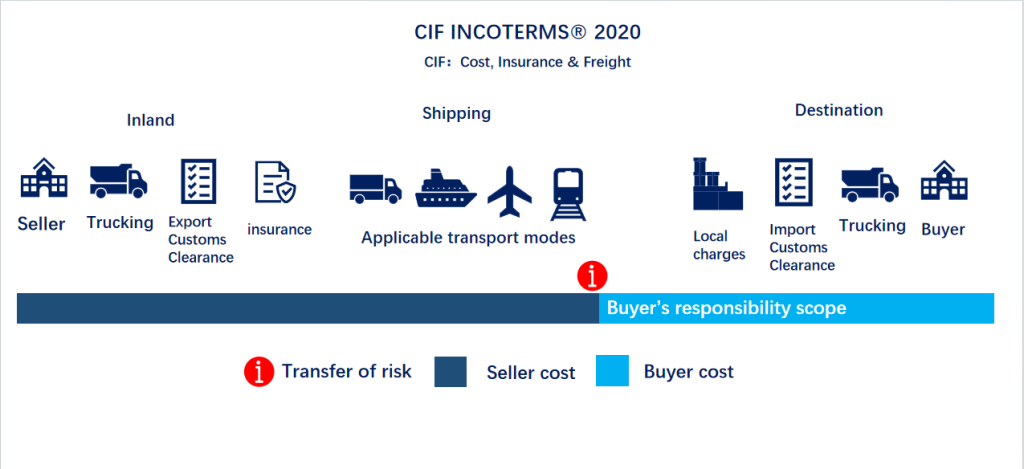
CIF: Cost, Insurance, and Freight
Under CIF terms,
the seller pays for the ocean freight and basic cargo insurance up to the destination port.
But many importers misunderstand CIF.
Here’s the key point you need to know:
-Risk transfers to the buyer
-the moment the cargo is loaded on board
at the origin port.
Yes, the seller pays for freight and insurance,
but the risk does not stay with them during the voyage.
Under CIF, the seller is usually responsible for:
1.Inland transportation within China
2.Export customs clearance in China
3.Basic cargo insurance
4.Ocean freight to the destination port
Once the cargo arrives at the destination port,
everything else is handled by the importer.
That includes:
1.Destination port charges
2.Import customs clearance
3.Duties and taxes
4.Final delivery
And this is where problems often happen.
Under CIF, importers usually do not control the freight forwarder,
and do not see the real cost structure.
In ocean shipping,some countries and trade lanes may have little or no destination charges due to local market practices or carrier pricing.
But in many countries, destination charges do exist and can be significant.
That’s why, when using CIF,you should always ask the seller in advance about destination port charges.
At the same time, you should clearly understand
your own import duties, customs clearance costs,
and last delivery expenses.
Otherwise, destination charges may turn out to be much higher than expected,and you’ll have very little room to negotiate.
So CIF may look convenient, but it doesn’t always mean lower risk or lower cost.
CIF works best when you fully trust the seller
and clearly understand the destination charges.
If you want more control, transparency,and cost predictability,CIF is not always the best option.