
FOB (Free on Board)
Complete Guide
Understanding FOB shipping terms - seller & buyer responsibilities, risk transfer, advantages, and practical examples for international trade from China.
What is FOB?
Understanding the most commonly used trade term in international shipping
Free on Board (FOB)
FOB is one of the most commonly used trade terms in international shipping. According to Incoterms 2020, FOB is applicable only to sea and inland waterway transport.
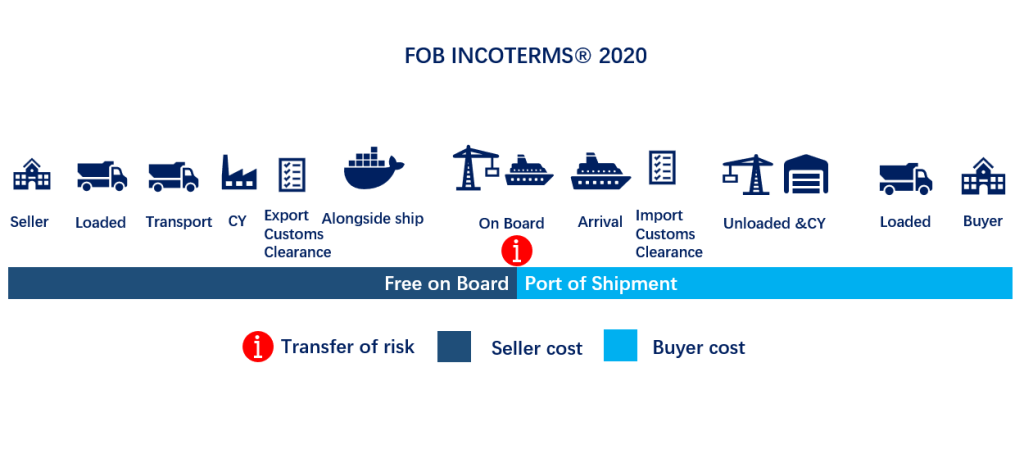
This means the seller is responsible for all costs and risks until the goods pass the ship's rail, including export customs clearance, duties, port charges, and loading fees. Once loaded, the risk transfers to the buyer.
Responsibility Breakdown
Clear allocation of responsibilities between seller and buyer
| Cost / Risk Item | Seller Responsibility | Buyer Responsibility |
|---|---|---|
| Goods production & packaging | ✓ Responsible | - |
| Transport to port of loading | ✓ Responsible | - |
| Export customs clearance | ✓ Responsible | - |
| Export duties & taxes | ✓ Responsible | - |
| Loading charges at port | ✓ Responsible | - |
| Ocean freight | - | ✓ Responsible |
| Insurance during transit | - | ✓ Responsible |
| Import customs clearance | - | ✓ Responsible |
| Import duties & taxes | - | ✓ Responsible |
| Transport from destination port | - | ✓ Responsible |
FOB Shipping Process
Step-by-step workflow from factory to destination port
FOB Timeline & Milestones
Key milestones and when responsibilities change hands
Sales Contract Signed
Buyer and seller agree on FOB terms, specifying the port of shipment and other trade conditions. The contract clearly defines that risk transfers when goods are loaded on board.
Goods Ready & Pickup
Seller completes production and packaging. Goods are transported from factory to the port of loading. Seller bears all costs and risks during this stage.
Export Customs Clearance
Seller handles all export formalities, prepares shipping documents (commercial invoice, packing list, bill of lading), and pays export duties if applicable.
Loading on Board (Critical Point)
RISK TRANSFER POINT: When goods are loaded on board the vessel, risk transfers from seller to buyer. Seller provides Bill of Lading as proof of loading.
Ocean Transit
Goods are in transit to destination port. Buyer is responsible for all costs and risks during ocean freight, including insurance if needed.
Arrival & Import Clearance
Vessel arrives at destination port. Buyer handles import customs clearance, pays import duties and taxes, and arranges transportation from port to final destination.
FOB vs Other Incoterms
Compare FOB with CIF, EXW, and DDP to understand the differences
| Cost / Risk Item | EXW | FOB | CIF | DDP |
|---|---|---|---|---|
| Transport to export port | ✗ | ✓ | ✓ | ✓ |
| Export customs clearance | ✗ | ✓ | ✓ | ✓ |
| Loading on vessel | ✗ | ✓ | ✓ | ✓ |
| Ocean freight | ✗ | ✗ | ✓ | ✓ |
| Insurance during transit | ✗ | ✗ | ✓ | ✓ |
| Import customs clearance | ✗ | ✗ | ✗ | ✓ |
| Import duties & taxes | ✗ | ✗ | ✗ | ✓ |
| Delivery to final destination | ✗ | ✗ | ✗ | ✓ |
Advantages & Considerations
Benefits and important considerations for both buyers and sellers
For Sellers: Lower Risk
Sellers have limited responsibility compared to other trade terms. No obligation for ocean freight and import clearance reduces complexity and potential liabilities.
For Buyers: Full Control
Buyers maintain complete control over carrier selection, shipping routes, and schedules. This allows for better cost optimization and logistics flexibility.
Cost Transparency
FOB pricing clearly separates product costs from shipping costs, making it easier to compare suppliers and negotiate better deals.
Ideal for Trust Relationships
FOB works best when buyers and sellers have established, trusted relationships with clear communication and mutual understanding.
Balanced Responsibility
FOB provides a fair balance of responsibilities - seller handles origin-side logistics while buyer controls destination-side operations.
Market Flexibility
Buyers can take advantage of their own freight forwarding relationships and negotiated rates, potentially reducing overall transportation costs.
Major FOB Ports in China
Popular ports for FOB shipments from China to worldwide destinations
DiamondUp offers FOB services from all major Chinese ports. Click to request rates.
Frequently Asked Questions
Common questions about FOB shipping terms
What's the difference between FOB and CIF?
FOB (Free on Board): Seller is responsible only until goods are loaded on the vessel at the port of shipment. Buyer pays for ocean freight and insurance.
CIF (Cost, Insurance, Freight): Seller pays for ocean freight and insurance to the destination port. Risk still transfers when goods are loaded on board, but seller covers freight costs.
Key Difference: CIF includes freight and insurance in the seller's price, while FOB does not. CIF gives the seller more control over shipping, while FOB gives the buyer more control.
When does risk transfer under FOB terms?
Under FOB terms (Incoterms 2020), risk transfers from seller to buyer when the goods are loaded on board the vessel at the named port of shipment. This is a critical point known as the "ship's rail."
Once the goods are loaded on board, the buyer bears all risks of loss or damage, even if the goods are damaged during ocean transit. This is why buyers often purchase cargo insurance for FOB shipments.
Who pays for freight under FOB?
Under FOB terms, the buyer pays for ocean freight. The seller's responsibility (and costs) end when the goods are loaded on the vessel.
However, the buyer typically arranges and pays for the freight through their own freight forwarder. The seller must ensure the goods are delivered to the port and loaded on the vessel nominated by the buyer.
What documents are provided under FOB?
Under FOB terms, the seller provides the following documents to the buyer:
- Bill of Lading (B/L): Proof of loading on board and title to goods
- Commercial Invoice: Detailed invoice showing goods and payment terms
- Packing List: Detailed list of packages, weights, and dimensions
- Export Documentation: Certificate of origin, inspection certificates if required
When should I use FOB instead of CIF or EXW?
Choose FOB when:
- You have a trusted relationship with your supplier
- You want control over shipping arrangements and carrier selection
- You have established logistics capabilities at destination
- You want to optimize shipping costs through your own forwarder
- You need transparency in freight pricing
Choose CIF when: You prefer the supplier to handle all shipping logistics.
Choose EXW when: You want complete control from the factory door and have local logistics capabilities in China.
Who arranges customs clearance under FOB?
Export customs clearance: The seller arranges and pays for export customs clearance at the port of shipment.
Import customs clearance: The buyer arranges and pays for import customs clearance at the destination port. This includes filing import declarations, paying import duties and taxes, and obtaining any necessary import permits.
Need Help with FOB Shipping?
Get expert guidance and competitive rates for your FOB shipments from China
Request FOB Rate
Fill out the form below and we'll get back to you within 24 hours