
EXW (Ex Works)
Complete Guide
The minimum obligation for sellers - buyer handles everything from pickup at factory to final destination.
What is EXW?
Understanding the minimum obligation Incoterm for international shipping
Ex Works (EXW)
EXW represents the minimum obligation for the seller. According to Incoterms 2020, EXW means the seller delivers when they place the goods at the disposal of the buyer at the seller's premises or another named place.
The buyer loads the goods and clears them for export, including all export formalities, duties, taxes, and transportation costs.
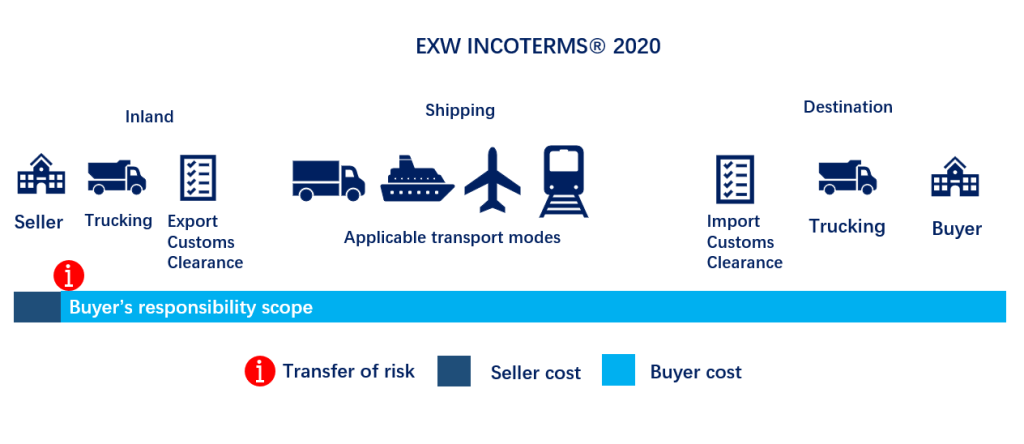
Responsibilities Breakdown
Buyer bears almost all responsibilities under EXW
🏭 Seller Responsibilities
- ✓ Produce/pack goods
- ✓ Make goods available at premises
- ✓ Provide commercial invoice
- ✗ NO loading on buyer's vehicle
- ✗ NO export clearance
- ✗ NO export duties/taxes
- ✗ NO transportation costs
- ✗ NO insurance during transit
📦 Buyer Responsibilities
- ✓ Pickup goods at seller's premises
- ✓ Loading onto vehicle
- ✓ Export customs clearance
- ✓ Export duties & taxes
- ✓ All transportation costs
- ✓ Insurance during transit
- ✓ Import clearance & duties
- ✓ Final delivery
EXW Shipping Process
Buyer manages everything from factory pickup to final destination
Goods Ready
Seller makes goods available
BuyerPickup & Loading
Buyer loads at factory
BuyerExport Clearance
Buyer handles export
BuyerTransit
Buyer arranges freight
BuyerImport Clearance
Buyer handles import
BuyerFinal Delivery
Buyer receives goods
Buyer⚠️ Important Warning
EXW should NOT be used for international shipments when:
- The buyer cannot directly or indirectly obtain export clearance
- The buyer is unfamiliar with export procedures in the seller's country
- The buyer wants to minimize logistics coordination
- The buyer lacks local representation or agents in the seller's country
Recommendation: Consider FCA (Free Carrier) or FOB instead for better risk allocation and logistics management.
EXW vs Other Incoterms(For Seller)
Compare EXW with FCA, FOB, CIF, and DDP
| Cost / Risk Item | EXW | FCA | FOB | CIF | DDP |
|---|---|---|---|---|---|
| Loading at factory | ✗ | ✓ | ✓ | ✓ | ✓ |
| Export clearance | ✗ | ✓ | ✓ | ✓ | ✓ |
| Transport to port | ✗ | ✓ | ✓ | ✓ | ✓ |
| Ocean/air freight | ✗ | ✗ | ✗ | ✓ | ✓ |
| Insurance | ✗ | ✗ | ✗ | ✓ | ✓ |
| Import clearance | ✗ | ✗ | ✗ | ✗ | ✓ |
| Delivery to door | ✗ | ✗ | ✗ | ✗ | ✓ |
Advantages of EXW
Why some buyers choose EXW terms
Maximum Price Control
Buyer can see the exact factory price without any shipping markups. Complete transparency in product costing.
Full Logistics Control
Buyer controls every aspect of shipping from carrier selection to routing and scheduling.
Consolidation Flexibility
Ideal for buyers who consolidate shipments from multiple suppliers before export.
Maximum Seller Benefit
Sellers have minimum responsibility and risk. No obligation beyond making goods available.
Important Considerations
Things to consider before choosing EXW
Local Knowledge Required
Buyer must have good understanding of seller's country export procedures and regulations.
Complex Export Clearance
Buyer handles export clearance which can be complex in certain countries with strict export controls.
Loading Responsibility
Buyer is responsible for loading goods at seller's premises. Ensure vehicle access and loading equipment.
Payment Risks
Seller receives payment before releasing goods. Buyer must ensure payment security and goods inspection.
Frequently Asked Questions
Common questions about EXW shipping
EXW (Ex Works): Seller only makes goods available at their premises. Buyer handles loading, export clearance, and all transportation.
FCA (Free Carrier): Seller delivers goods to the carrier nominated by buyer at seller's premises. Seller is responsible for loading.
Key Difference: Under FCA, seller loads goods onto buyer's vehicle. Under EXW, buyer loads.
Under EXW, the buyer handles export clearance. This includes all export documentation, licenses, and export duties or taxes.
This can be challenging for buyers unfamiliar with the seller's country export procedures.
Choose EXW when:
- You have local presence/agents in the seller's country
- You want maximum control over logistics
- You're consolidating from multiple suppliers
- You have established export capabilities
- You want complete transparency in factory pricing
Key risks include:
- Loading damage at seller's premises
- Export clearance delays or complications
- Coordination challenges with multiple suppliers
- Unexpected export duties or taxes
- Limited recourse if goods are damaged during loading
Under EXW, seller only needs to provide:
- Commercial Invoice
- Packing List
- Proof of goods availability
All export and transport documents are buyer's responsibility.
Who is EXW Best For?
Need Help with EXW Shipping?
Our team can handle all export logistics and transportation from Chinese factories
Get EXW Quote